
Cases of Interest

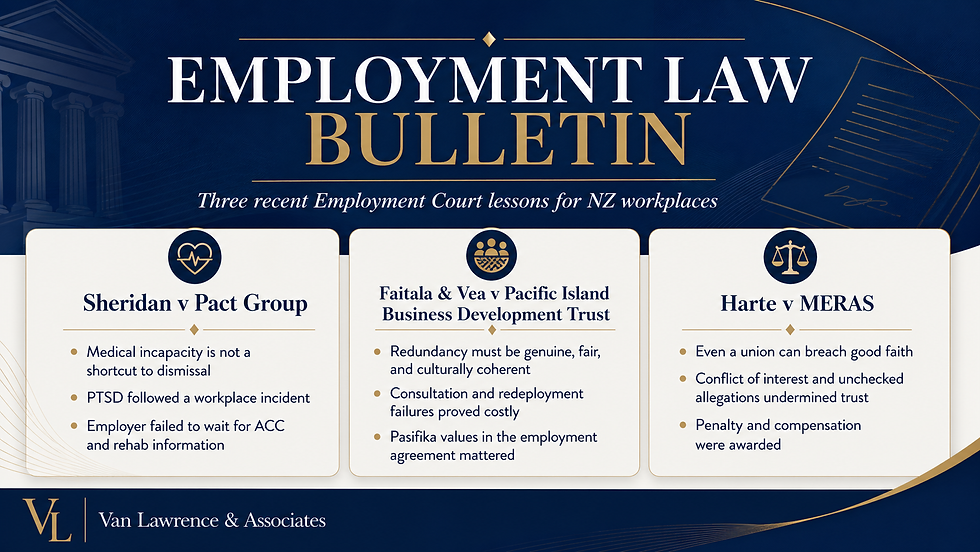
Sheridan v Pact Group: Medical incapacity is not a shortcut to dismissal
Summary
Ms Sheridan worked for Pact Group as a community support worker in a challenging residential care environment.
Following a workplace incident in January 2021, where a resident threatened to slit her throat, she developed PTS
D and went on sick leave.
Pact Group initially raised disciplinary concerns about how she handled the incident, but the matter then shifted toward medical incapacity.
The employer repeatedly asked Ms Sheridan for information about when she could return to work, even though she was waiting for ACC and specialist input.
Pact Group dismissed her for medical incapacity after about six months.
The Court found the dismissal unjustified.
Pact Group was a large national organisation and had more options available to manage operational pressure than simply dismissing her.
The Court criticised Pact Group for failing to properly engage with rehabilitation, failing to wait for relevant ACC information, and failing to apply its own rehabilitation policy.
Ms Sheridan was awarded $30,000 compensation for humiliation, loss of dignity and injury to feelings, plus lost wages.
Lesson learned
Employers do not have to keep a role open forever, but they do have to act fairly, patiently, and intelligently.
Where the medical incapacity arises from a workplace incident, the employer’s obligations are heavier.
A fair employer should ask: Can we rehabilitate? Can we adjust duties? Can we use temporary cover? Can we wait for medical information?
Dismissal should be the last step, not the administrative tidy-up.
For employees, the lesson is clear: if you are being pressured while waiting for medical or ACC information, that pressure may itself be legally significant.
Medical incapacity dismissals are fact-sensitive. Employers who rush them invite trouble.
The blunt lesson: you cannot injure someone at work, ignore rehabilitation, then complain that their recovery is inconvenient.
Faitala and Vea v Pacific Island Business Development Trust: Redundancy must be genuine, fair, and culturally coherent
Summary
Mr Faitala and Mrs Vea were senior employees of the Pacific Island Business Development Trust.
Their roles were disestablished during a restructuring process in 2023.
The Employment Relations Authority had already found their dismissals unjustified, but the employees challenged parts of the outcome, including remedies and the failure to uphold separate disadvantage grievances.
The Employment Court found serious procedural defects in the redundancy process.
The Trust failed to provide relevant information, failed to meaningfully answer questions, failed to properly consider redeployment, and failed to follow through on commitments made during consultation.
Importantly, the Court also found that the Trust failed to comply with Pasifika values that were incorporated into the employment relationship.
The Trust’s own documentation emphasised values such as respect, family, community, reciprocity, religion and spirituality.
The Court held that those values were not decoration. They mattered.
The failure to conduct the restructure consistently with those values unjustifiably disadvantaged the employees.
Mr Faitala received increased remedies, including six months’ lost remuneration and $30,000 compensation.
Mrs Vea received 12 months’ lost remuneration and $45,000 compensation, reflecting the greater impact on her.
Lesson learned
Redundancy is not magic dust. An employer cannot simply say “restructure” and avoid scrutiny.
A fair redundancy process requires real consultation, disclosure of relevant information, meaningful consideration of feedback, and genuine exploration of redeployment.
If an employment agreement incorporates cultural values, those values may become legally meaningful.
Employers who brand themselves around culture, community, and respect must actually behave that way when the relationship becomes difficult.
For employees, the lesson is powerful: procedural unfairness is not limited to cold technical breaches.
A process can be legally unfair because it ignores the human, cultural, and relational framework the employer itself promised to honour.
The blunt lesson: values in an employment agreement are not wall art.
Harte v MERAS: Even a union can breach good faith
Summary
Ms Harte was a self-employed midwife and a union member.
She sought support from her union, MERAS, during workplace difficulties involving Te Whatu Ora.
The same union official who had supported Ms Harte later supported another union member in matters adverse to Ms Harte’s interests.
The union failed to manage the conflict of interest properly.
It also failed to tell Ms Harte what had happened.
The Court found that the union acted against Ms Harte’s interests and undermined her employment relationship.
The union official later sent a letter to the employer raising serious concerns about Ms Harte, including vague allegations of bullying, laziness, poor role modelling and intimidation.
The Court found the allegations lacked specifics and had not been properly checked.
The Court accepted that the breaches were deliberate, serious, sustained, and damaging.
It found that Ms Harte had been let down by an organisation she was entitled to trust.
The union was ordered to pay a $12,000 penalty, with the whole amount payable to Ms Harte.
The Court also awarded $38,000 compensatory damages under its equity and good conscience jurisdiction.
Lesson learned
Good faith is not just an employer’s obligation.
Unions also owe duties to their members.
Where a union is advising or representing a member, it must manage conflicts of interest carefully.
It cannot quietly switch sides, use information gained from one member, or advance vague allegations without checking them.
This case is especially useful because many employees assume their only possible opponent is the employer.
That is not always true.
Representatives, unions, and advocates can cause real harm if they mishandle trust, confidentiality, and conflicts.
For unions, the lesson is severe: internal politics and divided loyalties do not excuse bad process.
For members, the lesson is empowering: if the people meant to protect you undermine you instead, the law may still have something to say.


Comments